

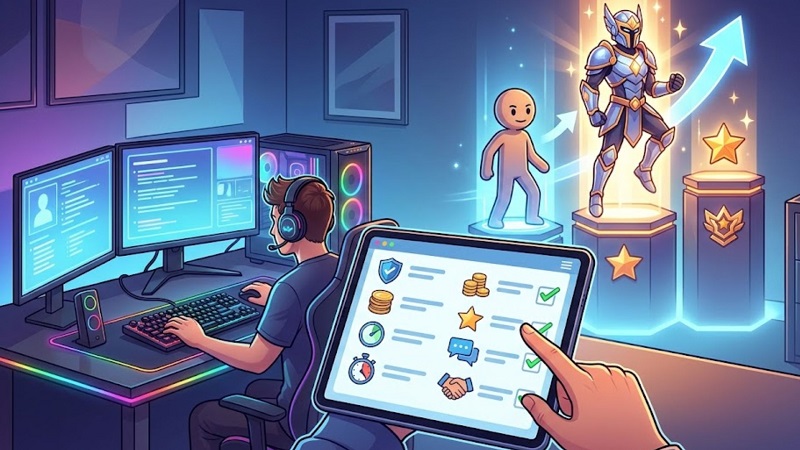
Buying a game boost is, at bottom, an act of trust. You pay upfront for someone you have never met to handle something you care about — sometimes including access to an account that holds years of progress. Most providers in 2026 are legitimate, but the category still carries its share of poorly run sellers and outright scams, and the difference is rarely obvious from a polished landing page. The good news: vetting a service is straightforward if you apply the same consumer-protection logic that works for any online purchase, plus a few boosting-specific checks. Run this checklist before you pay, and most of the risk disappears.
Why Vetting Matters More Here Than Elsewhere
The structure of a boosting purchase puts the buyer at a disadvantage. You typically pay first and receive the service afterward, so a dishonest seller has every incentive to take the money and underdeliver. Some methods also require account access, which raises the stakes far beyond the price of the order — a compromised account can cost you progress, items, and the account itself. That combination of upfront payment and potential credential exposure is exactly why a few minutes of due diligence is the cheapest insurance you will buy in this market.
| You pay first, and sometimes you hand over the keys. In a transaction structured that way, due diligence is not optional — it is the price of entry. |
The Buyer’s Checklist
Most bad experiences are avoidable with a handful of checks. The table pairs each thing to verify with what a good answer looks like — and the red flag that should make you walk away.
| Check before you pay | What good looks like | Red flag to avoid |
| Who does the work | Real, vetted human players | Bots or automation; vague answers |
| Method offered | Self-play / duo option available | Account-sharing as the only option |
| Scope & pricing | Itemized, fixed, shown before checkout | Hidden add-ons; price only “on request” |
| Support & contact | Reachable live support, real channel | No phone/address; only a dead contact form |
| Reviews & track record | Independent reviews you can verify | Only self-published testimonials |
| Payment method | Traceable, on-platform, escrow/staged | Gift cards, wire, or crypto to an individual |
| Refund & guarantee | Written policy and a completion guarantee | No policy; “all sales final” with no recourse |
| Where it happens | Inside the provider’s platform | Pushed to private off-platform chat |
None of these checks requires expertise — just the discipline to run them before money changes hands. Several map directly onto long-standing consumer-protection advice: legitimate sellers do not demand untraceable payment like gift cards or wire transfers, and pressure to move a deal off the official platform into a private chat is one of the clearest warning signs in any online transaction.
The Trust Signals That Actually Matter
Not all reassurance is equal. The signals below are ranked by how hard they are to fake — which is exactly how much weight you should give them.
| Trust signal | Reliability | Why |
| Independent, verifiable reviews | Highest | Hard to fabricate at scale; reflects real history |
| Reachable, responsive support | High | A real operation answers before you pay |
| Transparent, itemized pricing | High | Signals a business expecting to be judged on delivery |
| Self-play / account-safe methods | High | Removes the biggest source of account risk |
| On-site testimonials only | Low | Written by the seller; easily curated |
| “Trust” and “secure” in the branding | Lowest | Words are free; scammers lean on them hardest |
The practical move is to look outside the seller’s own website. Independent reviews, a visible track record and a history you can check carry far more weight than testimonials a company writes about itself — and the most reassuring providers make these easy to find rather than burying them. A platform such as xboosty.com, for instance, surfaces its reviews, methods and terms openly, which is the kind of transparency that lets you judge a service on evidence instead of on promises.
What “Account-Safe” Actually Means
The phrase “safe” gets used loosely, so it helps to be specific about what reduces account risk. The single biggest factor is the method: self-play and coaching never require your login, while a piloted boost does. If you use a piloted service, the questions worth asking are concrete — does the booster use region-matched handling, will they avoid logging in from a flagged location, and is there a clear protocol if something looks wrong? A provider that answers these plainly is treating account safety as a feature; one that waves them away is not. When in doubt, choosing a self-play option removes the question entirely, because your credentials never leave your hands.
Red Flags That Should End the Conversation
Some signals are not just cautionary — they are reasons to stop. A price dramatically below everyone else’s is usually the hook, not a bargain: quality boosting has real labour costs, and “too good to be true” almost always is. Walk away from any service with no contactable support, no external reviews, demands for payment through untraceable channels, account-sharing as the only method, or evasive answers about who does the work. When two or three of these stack up, the cheapest decision is simply to choose someone else.
A 60-Second Pre-Purchase Routine
You do not need an investigation. Before you pay, do four quick things: search the provider’s name plus “review” to find independent feedback; message support with a real question and see how fast a human answers; confirm the scope, price and refund policy are written down before checkout; and check that payment stays on a traceable, on-platform method. If all four hold up, you have filtered out the overwhelming majority of bad outcomes before they could ever start.
Vetting a boosting service is not about paranoia — it is about treating the purchase like any other considered online transaction. The buyer who runs the checklist is not being difficult; they are being the kind of customer that good providers want and bad ones avoid.
Frequently Asked Questions
How do I know if a boosting service is legitimate?
Check four things: that real human players do the work, that scope and pricing are transparent, that support is responsive and reachable, and that independent reviews back the claims. A service that passes all four — and keeps payment on a traceable, on-platform method — is very likely legitimate.
Should I pay upfront for a boost?
Some upfront payment is normal, but favour services using escrow or staged payments on a traceable method rather than demanding the full amount via gift cards, wire transfers or crypto to an individual. Untraceable payment is one of the clearest scam signals in any online purchase.
What are the biggest red flags in a boosting service?
No reachable support, no external reviews, prices far below the market, account-sharing as the only method, pressure to move off-platform into private chat, and evasiveness about who does the work. Two or three of these together is reason enough to walk away.
Are boosting services safe for my account?
It depends on the method and the provider. Self-play and coaching keep your credentials private, while piloted boosting involves account access and more exposure. Choosing a vetted service that uses real human players, account-safe methods and clear protocols meaningfully reduces the risk.