

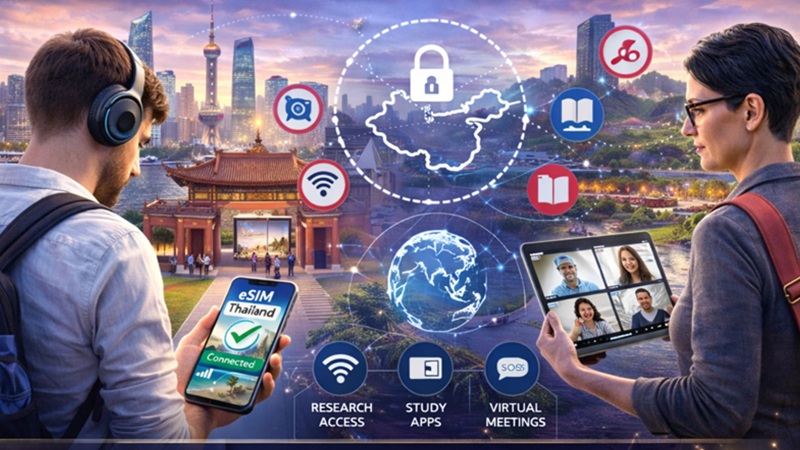
International education continues to expand in scope and complexity. In recent years, China has remained one of the most significant destinations for academic exchange, research collaboration, and study abroad programs. From semester-long university placements to short-term teaching fellowships and international conferences, thousands of American students and educators travel to China each year.
While most academic travelers focus on visas, housing arrangements, health insurance, and course planning, one essential component of preparation is often underestimated: reliable mobile connectivity.
In 2026, education is deeply intertwined with digital infrastructure. Access to cloud platforms, online research databases, messaging tools, digital libraries, and virtual learning environments is not optional—it is foundational. For students and educators traveling to China, understanding the local digital environment and planning connectivity in advance can make a significant difference in both academic performance and overall experience.
The Growing Importance of Academic Exchange with China
China remains a global hub for research, innovation, language studies, and international collaboration. American universities maintain partnerships with Chinese institutions across fields such as engineering, business, environmental science, technology, and cultural studies.
Study abroad participants may enroll in courses at Chinese universities, conduct field research, or complete internships. Faculty members often participate in collaborative research projects, conferences, and visiting lecturer programs.
In all of these scenarios, digital access is critical. Coursework materials are frequently hosted online. Research articles are accessed through digital databases. Assignments are submitted via learning management systems. Faculty communication occurs through email and collaborative platforms.
Without dependable internet access, academic engagement becomes more challenging.
Understanding China’s Digital Environment
One of the most important considerations for travelers to China is the country’s unique internet framework. Certain Western websites and services—including Google services, Gmail, Google Drive, and some communication platforms—may not function normally without additional configuration.
This does not mean that connectivity is unavailable. China has an extensive and advanced telecommunications infrastructure. However, the structure of the digital ecosystem differs from what American students and educators are accustomed to.
For academic travelers, this difference can create temporary disruptions if not anticipated. Accessing familiar cloud storage platforms, coordinating through messaging apps, or retrieving research documents may require planning.
Rather than viewing this as a barrier, it is best understood as an environmental factor that requires preparation—much like adapting to a new academic calendar or cultural norms.
Why Traditional Roaming May Not Be Ideal for Students
Many American travelers assume they can rely on international roaming through their domestic mobile carrier. While this option is convenient, it may not be the most practical solution for students or educators spending weeks or months abroad.
Common limitations include:
● High daily roaming fees
● Limited data allowances
● Reduced speeds after data caps
● Unpredictable total costs
For students operating within a fixed budget, roaming expenses can quickly become burdensome. Academic tasks such as downloading research papers, participating in video calls, or accessing digital learning platforms consume significant data.
Educators conducting research or maintaining communication with institutions in the United States may face similar constraints.
In short-term tourism, limited roaming data might be manageable. In an academic setting, it can become restrictive.
eSIM Technology as a Practical Academic Solution
eSIM (embedded SIM) technology offers an alternative approach. Unlike traditional physical SIM cards, an eSIM allows users to download a mobile data plan directly onto their compatible smartphone. Activation occurs digitally, often before departure.
Most newer smartphones in the United States, like the updated iPhones, Samsung Galaxy, and Google Pixel models, have eSIM functionality built in.
For academic travelers, the advantages include:
● Activation before departure from the U.S.
● Immediate connectivity upon arrival
● No need to replace a physical SIM card
● Transparent prepaid data options
● Flexibility to maintain a primary U.S. number
Because eSIM plans can be selected and activated in advance, they provide greater clarity around pricing and usage.
Students preparing for academic travel often compare data solutions in advance. Here, understanding the various pros and cons of different eSIMs like Myroami best eSIM China is necessary to ensure reliable mobile access throughout their stay.
Comparing providers beforehand allows travelers to evaluate coverage, data allowances, and cost structures that align with the length and purpose of their academic program.
Who Benefits Most from Advanced Connectivity Planning?
While all academic travelers can benefit from reliable mobile access, certain groups may find it particularly essential:
1. Study Abroad Students
Undergraduate and graduate students participating in semester programs rely heavily on digital resources. Course syllabi, reading materials, and assignments are often distributed online. Immediate connectivity supports academic continuity.
2. Researchers and Graduate Scholars
Field researchers and doctoral candidates may need constant access to data collection tools, reference materials, and collaboration platforms. Mobile connectivity serves as an extension of their research infrastructure.
3. Visiting Faculty
Professors and lecturers frequently maintain responsibilities at their home institutions while teaching abroad. Consistent access to email, shared documents, and academic databases is critical.
4. Conference Attendees
Academic conferences often use digital schedules, QR-based registration, and online abstract submissions. Connectivity supports participation and networking.
5. Short-Term Exchange Participants
Even brief academic visits benefit from pre-arranged data access, reducing stress upon arrival and enabling smoother transitions into campus life.
Digital Preparedness as Part of Study Abroad Planning
Academic preparation for international travel now includes digital readiness. In addition to confirming course credits and housing, students and faculty should consider:
● Verifying smartphone compatibility with eSIM technology
● Downloading necessary academic apps in advance
● Saving essential documents offline
● Understanding data requirements for their coursework
● Budgeting for mobile data alongside other expenses
Institutions may provide guidance on digital tools commonly used within their programs. However, personal connectivity planning remains an individual responsibility.
Being digitally prepared enhances both academic performance and daily convenience. Navigation apps assist with commuting to campus. Translation tools support communication. Messaging platforms facilitate social integration.
Connectivity Supports Well-Being and Safety
Beyond academics, reliable mobile connectivity also contributes to personal well-being and safety.
Students studying abroad may need to:
● Contact local program coordinators
● Access emergency services
● Communicate with family in the U.S.
● Receive travel updates
Faculty members may need to coordinate logistics or respond to time-sensitive institutional matters.
Having dependable mobile data reduces anxiety and enhances independence in a new environment.
The Future of International Education Is Digital
Global education continues to evolve alongside technology. Hybrid learning models, virtual collaboration, and cloud-based research have become standard components of academic life.
As universities strengthen international partnerships, students and educators must navigate not only cultural differences but also digital ecosystems.
Planning for connectivity is no longer a minor logistical detail—it is part of academic preparedness.
eSIM technology reflects the broader shift toward flexible, software-based infrastructure. By removing the need for physical SIM swaps and enabling pre-arranged data plans, it aligns with the digital transformation underway across higher education.
Conclusion
Studying or teaching in China offers invaluable academic and cultural opportunities. From research collaboration to immersive language learning, the experience can be transformative.
However, successful participation in international education requires thoughtful preparation. Reliable mobile connectivity supports coursework, research, communication, and personal well-being.
Rather than relying solely on roaming or airport solutions, academic travelers can benefit from comparing data options before departure. By approaching connectivity as part of their educational toolkit, students and faculty position themselves for a smoother and more productive experience abroad.
In 2026, academic readiness extends beyond textbooks and travel documents. It includes digital preparedness—ensuring that wherever learning takes place, connection remains uninterrupted.